
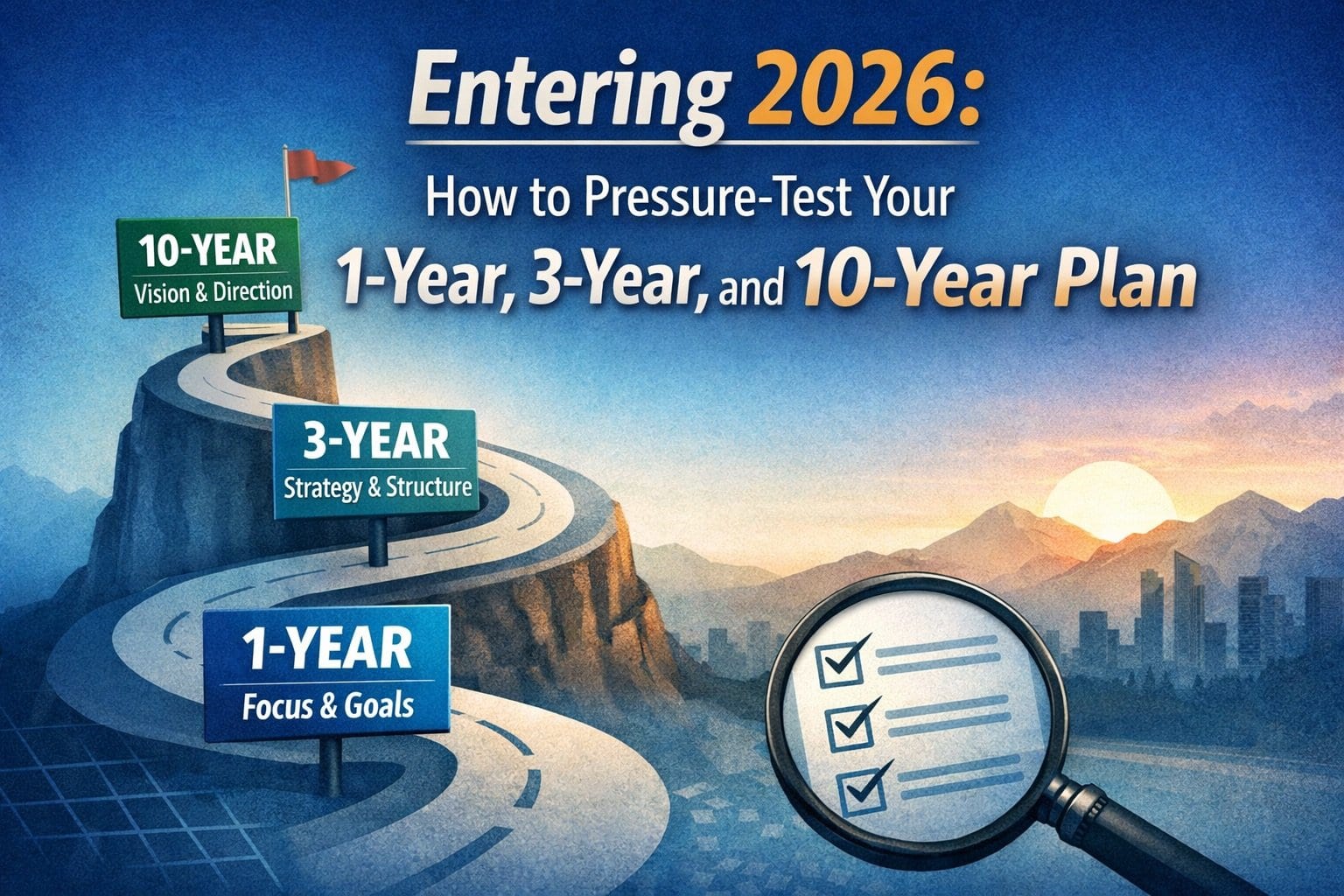
If you’re already running on EOS®, you likely have a 1-Year, 3-Year, and 10-Year plan.
As we enter 2026, the question isn’t whether those plans exist.
It’s whether they’re still doing the work they’re meant to do.
This moment isn’t about rewriting your vision. It’s about pressure-testing your thinking to ensure your plans are still aligned with where your business — and leadership team — are headed.
The 10-Year Vision: Is It Still Pulling the Team Forward?
Your 10-Year target should create clarity and energy, not distance.
Use it as a lens to ask:
- Does this vision still feel aspirational, or has it gone stale?
- Would a new leader clearly understand what “winning” looks like here?
- Does this vision still guide big decisions, or does it live quietly in a document?
When leadership teams drift, it’s rarely because the long-term vision is wrong.
More often, it’s because the vision is no longer present in day-to-day leadership conversations.
A strong 10-Year vision should continue to pull the organization forward — even when the path isn’t linear.
The 3-Year Picture: Is It Still Believable?
The 3-Year plan is where vision meets reality.
It should feel challenging but achievable, grounded in real assumptions about:
- Revenue and profitability
- Organizational structure and leadership capacity
- Operational maturity and systems
Pressure-test your 3-Year thinking by asking:
- Are our assumptions still realistic given today’s market and pace of growth?
- Does our Accountability Chart reflect where we’re going, not just where we’ve been?
- What capabilities must strengthen over the next 36 months for us to succeed?
If the 3-Year picture feels fuzzy or outdated, leadership teams often default to short-term decisions that don’t compound over time.
The 1-Year Plan: Is It Focused Enough?
The 1-Year plan is where strategy turns into restraint.
This is the point where leadership teams must decide what not to pursue.
Revisit:
- Are our annual priorities clear, limited, and aligned?
- Do our quarterly Rocks directly support the 1-Year goals?
- Are we intentionally saying “no” as often as we say “yes”?
Burnout often shows up when everything feels important.
Focus restores momentum.
A strong 1-Year plan should simplify decision-making and create confidence in execution.
How Long-Term Planning Shows Up in Weekly Leadership Rhythm
Planning in 1-, 3-, and 10-Year horizons isn’t meant to live only in annual sessions.
It should quietly shape how leaders think and act every week.
Look for alignment in:
- IDS topics that connect back to long-term issues
- Scorecard measurables that signal future readiness
- Leadership conversations that reference where the company is going, not just what’s urgent
If the future never comes up in weekly meetings, it’s likely still driving decisions — just unconsciously.
The Real Work Entering 2026
You don’t need a new plan.
You need deeper alignment with the plan you already have.
The most effective leadership teams use their 1-, 3-, and 10-Year thinking as:
- A decision filter
- A leadership development tool
- A way to reduce noise and reactivity
That’s how planning turns into traction.
A Final Reflection for Leadership Teams
As you head into 2026, consider bringing this question into your next quarterly or annual session:
Are our plans still serving us — or have we outgrown our own thinking?
Growth requires recalibration.
Clarity creates momentum.